
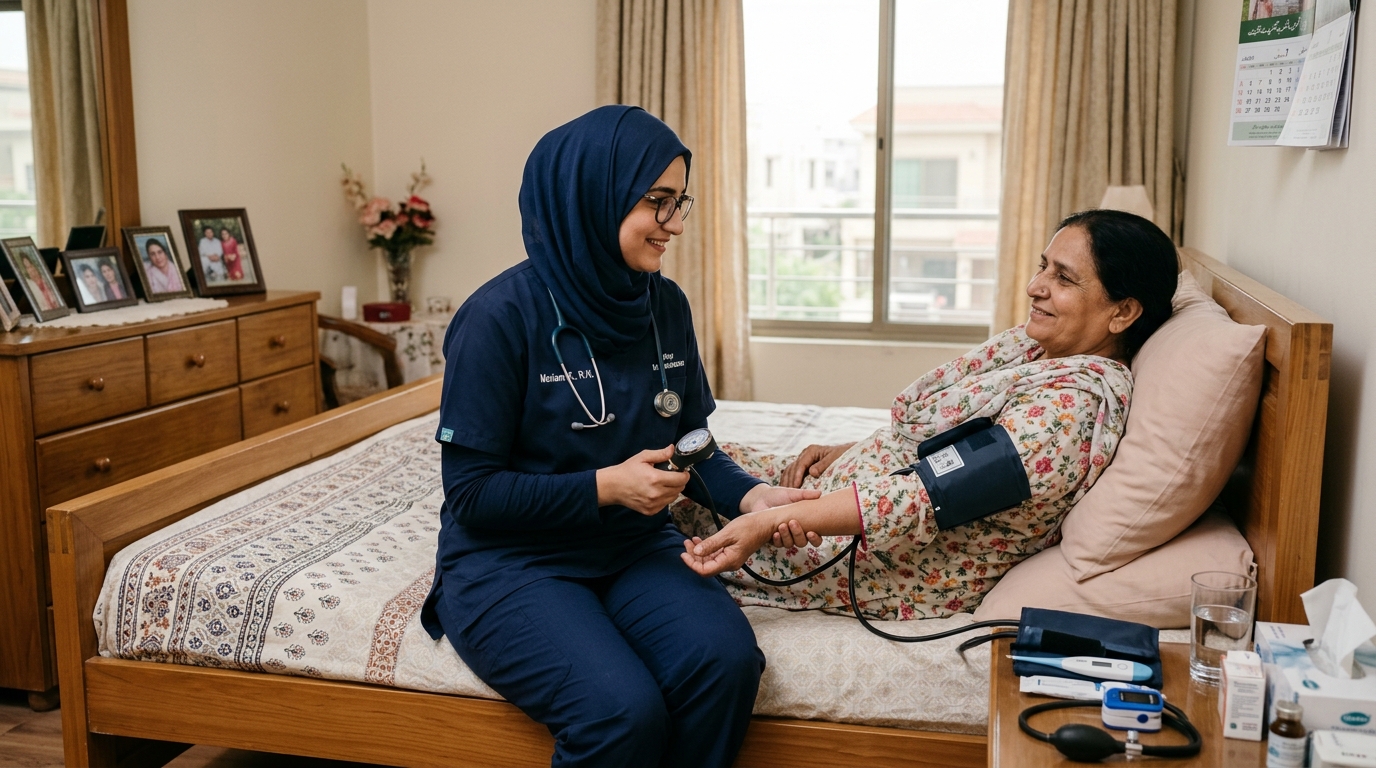
Finding a dedicated and verified patient caretaker in Islamabad and Rawalpindi is one of the most important decisions a family makes when a loved one falls ill or grows frail. Whether you have aging parents requiring daily mobility support, a loved one recovering from major surgery, or a family member who is bedridden, having professional bedside care at home protects their safety, comfort, and self-respect.
Across Islamabad and Rawalpindi, fast-paced work routines and nuclear family dynamics mean that balancing careers with attentive elder care can become overwhelming. When health emergencies happen, searches like patient ke liye attendant chahiye, buzurgon ki dekhbhal, or mareez ki dekhbhal ghar par surge as families look for urgent help. However, entrusting an ailing elder to an untrained domestic worker carries grave hazards, including painful bedsores, falls, and medication errors. Families also often search for a ghar par nurse Islamabad when a trained bedside attendant is actually what is required.
At Care Nest Home Healthcare, founded by registered medical professionals, we help families navigate in-home care seamlessly. This definitive 2026 guide covers daily bedside duties, how to choose between a patient caretaker at home and a clinical nurse, realistic monthly charges across Islamabad and Rawalpindi, 12h/24h shifts, and step-by-step verification protocols.
- 1. What Does a Caretaker Do at Home? (Duties)
- 2. What is a Caretaker’s Patient Called?
- 3. Caretaker vs Home Nurse – Which One Do You Need?
- 4. Male or Female Caretaker – How to Choose
- 5. 12-Hour vs 24-Hour Care Shifts
- 6. Caretaker Charges & Salary in Islamabad & Rawalpindi
- 7. How to Hire a Verified Attendant (Step by Step)
- 8. Why is Caregiving So Hard?
- 9. How to Help Old People at Home?
- 10. Areas We Serve in Islamabad & Rawalpindi
- 11. Frequently Asked Questions (Google PAA)
What Does a Patient Caretaker Do at Home?
When families ask: What are the duties of a caretaker?, the answer centers on Activities of Daily Living (ADLs). A patient caretaker is a trained non-clinical or semi-clinical caregiver who assists individuals unable to perform basic self-care independently due to age, injury, stroke, or post-operative weakness.
Through structured home patient care services in Islamabad and Rawalpindi, a trained attendant handles essential daily tasks:
- Bathing and Grooming: Administering daily sponge baths in bed for bedridden patients or assisting mobile seniors with walk-in showers. This includes oral hygiene, hair combing, nail cleaning, shaving, and changing clothes.
- Feeding Assistance: Serving doctor-recommended meals, patiently spoon-feeding individuals with tremors or paralysis, ensuring balanced hydration, and assisting with pureed diets.
- Mobility and Transfer Support: Safely moving patients from bed to wheelchair, wheelchair to commode, or assisting them during gentle hallway walks using proper body biomechanics to prevent slips.
- Wheelchair Assistance: Assisting seniors outdoors for fresh air, garden strolls, and hospital visits for follow-up doctor appointments.
- Medication Reminders: Promptly reminding the patient to take prescribed medications with water according to medical schedules, and logging daily blood pressure and blood sugar.
- Bedsore Prevention: Turning paralyzed or bedridden individuals every two hours to relieve pressure on the sacrum, hips, and heels, applying barrier creams, and checking air mattress function.
- Specialized Bedside Care: Expert attendants deliver dedicated stroke patient care, paralysis patient care, and post surgery care at home, preventing joint contractures and muscle stiffness.
- Companionship for Elderly: Engaging seniors with heartfelt conversations, listening to their memories, reading newspapers, and combating social isolation.
What is a Caretaker’s Patient Called?
Google searchers commonly inquire: What is a caretaker’s patient called? Depending on the care environment and healthcare context, several respectful terms are used:
- Care Recipient: The internationally standard healthcare term, highlighting dignity, person-centered support, and active collaboration.
- Client: Used by professional agencies to reflect high-touch service and family autonomy.
- Patient: Preferred when the individual is under active recovery from medical issues such as stroke rehabilitation or orthopedic surgery.
- Resident: Used if the individual resides in a nursing facility or assisted care home.
In Pakistan, attendants treat them respectfully as senior family elders (buzurg), honouring their generational wisdom.
Patient Caretaker vs Home Nurse – Which One Do You Need?
A common point of confusion is: Patient caretaker vs home nurse, what is the difference? Understanding the boundary between daily bedside support and medical nursing saves families from both medical complications and inflated expenses.
A patient care attendant Rawalpindi focuses on personal hygiene, nutrition, mobility, and emotional comfort. In contrast, a registered home nurse is a PNMC-licensed clinical professional responsible for clinical tasks such as IV cannulation, IV drip administration, surgical drain management, Foley catheterization, and sterile wound dressings.
| Aspect | Bedside Attendant / Caretaker | Registered Home Nurse (RN) |
|---|---|---|
| Primary Role | Daily personal hygiene, feeding, mobility, and companionship. | Clinical medical care, injections, catheter, and wound healing. |
| Qualifications | Attendant training certificate, hospital bedside experience. | Diploma in Nursing / BSN registered with PNMC. |
| Clinical Tasks | Non-invasive (vitals tracking, sponge bath, diaper change). | Invasive (IV cannulas, injections, Foley catheter, Ryle's tube). |
| Best Fit For | Seniors, stroke mobility assistance, chronic bedridden routines. | Post-ICU recovery, complex surgical incisions, oncology support. |
| Monthly Cost Range | Rs. 38,000 – Rs. 85,000 / month | Rs. 55,000 – Rs. 130,000 / month |
If your family member requires clinical injections, catheter care, or surgical wound management, read our detailed guide on home nursing services in Rawalpindi & Islamabad. If their needs focus on bathing, feeding, and walking, hiring a dedicated attendant is the ideal choice.
Male or Female Patient Caretaker – How to Choose
Choosing a male and female patient caretaker depends on your loved one’s personal preference, physical requirements, and cultural modesty:
- Female Attendant / Caregiver: Best suited for elderly mothers, grandmothers, female stroke patients, and young female patients recovering from surgery. Ensures utmost modesty during sponge baths, clothing changes, and personal hygiene.
- Male Attendant / Caregiver: Recommended for elderly fathers, male stroke patients, or heavy bedridden individuals who require physical strength for lifting, commode transfers, and wheelchair movement.
12-Hour vs 24-Hour Patient Caretaker Shifts
Whether your family requires a 12 hour day / night caretaker or continuous 24/7 bedside assistance, Care Nest provides flexible schedules across the Twin Cities:
- 12-Hour Day Shift: Ideal for households where family members work during daytime hours. The attendant manages morning hygiene, breakfast, lunch, medication reminders, and afternoon walks.
- 12-Hour Night Shift: Essential for restless patients, dementia wandering, or bedridden individuals who require turning every two hours at night to prevent bedsores, giving family members uninterrupted rest.
- 24-Hour Live-In Shift: A dedicated live-in patient attendant who resides in the home, delivering round-the-clock peace of mind. This is the preferred choice for bedridden patient care at home or when family members reside abroad.
Explore our complete range of day, night, and live-in schedules on our care shifts and options page.
Patient Caretaker Charges in Islamabad & Rawalpindi
Cost transparency helps families plan home care with confidence. When researching patient caretaker charges in Islamabad, home nursing services charges in Islamabad, 24 hour attendant price Rawalpindi, or monthly patient caretaker salary Islamabad, families deserve clear, honest rates.
Care Nest offers genuine, competitive starting-from rates for Islamabad and Rawalpindi in 2026:
| Service Tier | Shift Type | Estimated Daily Rate | Starting Monthly Range (PKR) |
|---|---|---|---|
| 12-Hour Day Attendant | 12h Day | Rs. 1,600 – Rs. 2,000 / day | Rs. 38,000 – Rs. 48,000 / month |
| 12-Hour Night Attendant | 12h Night | Rs. 1,800 – Rs. 2,200 / day | Rs. 42,000 – Rs. 52,000 / month |
| 24-Hour Live-In Attendant | 24h Live-In | Rs. 2,500 – Rs. 3,200 / day | Rs. 65,000 – Rs. 85,000 / month |
| 12-Hour Clinical Home Nurse | 12h Clinical | Rs. 2,500 – Rs. 3,200 / day | Rs. 55,000 – Rs. 75,000 / month |
| 24-Hour Live-In Clinical Nurse | 24h Clinical | Rs. 3,800 – Rs. 5,000 / day | Rs. 95,000 – Rs. 130,000 / month |
Factors Impacting Final Pricing: Total charges depend on patient weight, mobility (assisted walker vs fully bedridden), specialized tube management, and whether private accommodation is provided for live-in attendants.
How to Hire a Verified Patient Caretaker (Step by Step)
Inviting a caregiver into your home requires complete trust. Follow this reliable 4-step hiring process:
- Identify Care Needs: Determine the patient's daily dependency level, preferred shift (12h day/night or 24/7 live-in), and whether a male or female attendant is required.
- Insist on Verification: Never hire an attendant without NADRA CNIC biometric confirmation, local police clearance certificate, and verified bedside experience from recognized hospitals.
- Contact Care Nest: Call our 24/7 helpline at 0339 0546445 or fill our online patient registration form.
- Rapid Deployment & Trial: We assign a matched, background-cleared attendant within 2 to 4 hours, backed by an immediate replacement guarantee if compatibility is not optimal.
Why is Caregiving So Hard?
When people ask: Why is caregiving so hard?, they reflect the profound physical and psychological exhaustion experienced by family caregivers.
Caring for an ailing family member involves interrupted sleep, lifting heavy adult bodies, emotional distress from watching a parent decline, and career stress. A professional caregiver in Islamabad relieves this physical and emotional burden, enabling family members to maintain their own health and preserve loving family bonds.
How to Help Old People at Home?
If you are managing elderly care Islamabad or Rawalpindi independently, implement these core safety principles:
- Fall Prevention: Fit anti-slip mats and sturdy grab handles in bathrooms, remove loose rugs, and keep pathways well-lit at night.
- Hydration and Nutrition: Offer water, broths, and fresh fluids regularly to prevent painful urinary tract infections and dehydration.
- Structured Routines: Maintain consistent meal and sleep schedules to reduce restlessness and cognitive confusion.
- Professional Support: Hiring a dedicated caretaker for elderly at home ensures safety during bed-to-chair transfers and bathing.
Areas We Serve in Islamabad & Rawalpindi
Care Nest deploys verified caretakers across all major residential sectors in the Twin Cities:
Whether you need a patient caretaker DHA Islamabad, a patient caretaker Bahria Town Rawalpindi, an experienced patient attendant F-10 / F-11 / G-11 / I-8 Islamabad, elderly care Gulberg Greens, or a reliable caretaker Askari / Chaklala / Westridge Rawalpindi, our mobile teams dispatch verified personnel within 2 to 4 hours. You can also read about our regional expansion in our Azad Kashmir healthcare blog.
FAQs: Frequently Asked Questions
Get Started with Verified Twin Cities Home Care
Looking after an ailing or elderly parent requires patience, love, and professional assistance. Care Nest provides reliable, vetted attendants and hospital-standard supervision directly to your home.